
Slots and Blackjack Stay the Easiest Casino Games for Beginners in 2026
Slot machines and blackjack remain the two most beginner friendly casino games because you can start with minimal rules and make only a few decisions per round. Roulette and video poker also fit new players because the odds are clear and the betting options are easy to practice without memorising long rulebooks.
This guide explains how each game works, how payouts are calculated, what the house edge means, and how to set a bankroll plan that keeps losses controlled. All examples reflect standard casino rules used in 2025–2026 in major regulated markets. Exact rules can still vary by venue so always confirm the table sign or the game help screen.
Beginner Games and What Makes Them Simple
Casino Lucky Twice and similar licensed casinos usually highlight beginner tables and low stake slots because they reduce the number of choices you must make and show limits clearly.
A casino game is a paid chance based activity where the casino offers fixed rules for how bets are placed and how outcomes are paid. For beginners, the best starting point is a game where the operational steps are short and the house edge is visible or easy to estimate.
How to Judge a Game Before You Play
Use three checks that you can verify in under one minute.
Before the checklist, note this: the house edge is the average share of each bet the casino keeps over the long run. It does not predict short sessions but it is the best single number for comparing games.
Checklist:
- Rules load: count how many decisions you must make per round
- Odds visibility: see if payouts and probabilities are shown on a paytable or layout
- Cost control: confirm minimum bet, maximum bet, and whether you can stop at any moment
Slots as a First Step Because the Play Loop Is Fixed
A slot is an RNG driven game where each spin is generated by a random number generator and then mapped to reel symbols. Operationally you set a stake, press spin, and the game pays based on the paytable for the symbol combination and any bonus rules.
What the Paytable and RTP Actually Mean
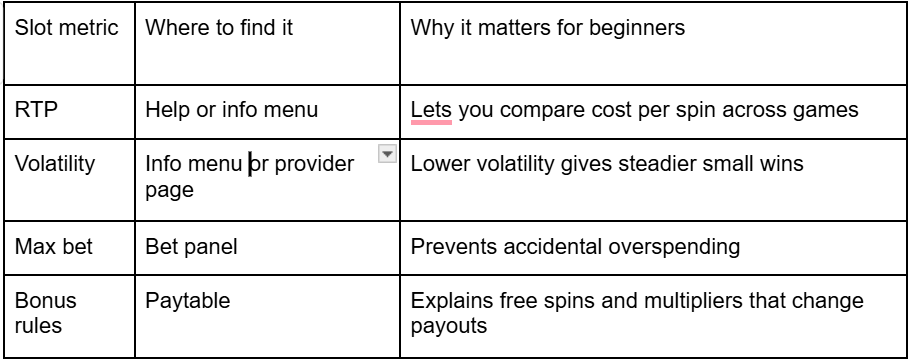
The paytable is the rule sheet for payouts. RTP is the theoretical return to player over a very large number of spins. A slot with 96% RTP has a 4% house edge in theory. Volatility is different: it describes how payouts are distributed. High volatility means fewer wins but larger peaks.
Before the table, here is what to look for in the game info screen.
Beginner Slot Routine That Reduces Mistakes
This short routine is practical and matches how regulated casinos describe responsible play.
Steps:
- Set a session bankroll and a hard stop loss amount
- Choose a slot with published RTP and clear paytable
- Start at the minimum bet for 20 spins to learn the features
- Increase stake only if the current stake still fits your stop loss plan
- Never chase losses by doubling bets after a bad run because each spin is independent RNG
Blackjack Because Decisions Are Limited and Strategy Is Learnable
Blackjack is a comparing card game against the dealer. Your goal is to finish with a hand total closer to 21 than the dealer without going over. The operational mechanism is stable: you receive two cards, decide how to play, the dealer follows fixed rules, then payouts are settled.
Core Rules and the Bets That Matter
Most beginner friendly tables use these base rules: dealer stands on 17, blackjack pays 3:2, and you may double on two cards. Some tables pay 6:5 for blackjack which increases the house edge a lot and is a poor choice for beginners.
Before the list, here are the bet types you will see most often.
- Main bet: required stake for the hand
- Double down: you double the bet and take exactly one more card
- Split: if you have a pair you create two hands with an extra bet
- Insurance: side bet when dealer shows an Ace, usually not good value for beginners