
Mobile Poker Apps and the Rise of Playing Poker on the Go
Poker once meant sitting at a computer with enough time for a full session. Now, players can open a table while waiting for a train, taking a break or relaxing at home.
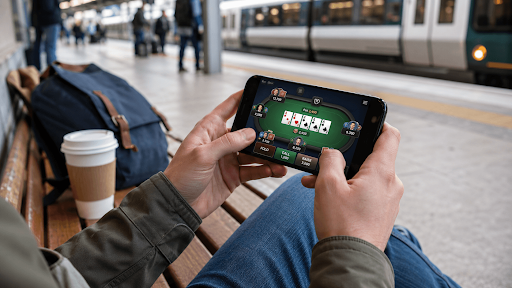
The growth of mobile poker apps has made the game much easier to fit into everyday life. A phone cannot match every advantage of a desktop setup, but it offers something more useful for many players: freedom to play almost anywhere.
Why Poker Moved to Mobile
Phones got faster. Screens got bigger. Connections stopped dropping mid-hand. That combination is really what made real-time poker on a phone feel playable instead of frustrating — nobody wants to lose a pot because the app lagged for two seconds. App design caught up too, eventually. Those old cramped layouts, half-copied from desktop sites, gave way to touch controls that actually fit a thumb.
None of that is cosmetic. Poker runs on a clock. You’ve got to read your cards, glance at the board, register the bet size, and act — all before that timer runs out. Miss any one of those and you’re folding hands you shouldn’t, or worse, misclicking a raise you didn’t mean to make.
So the best mobile poker apps usually aren’t the ones bragging about fifty features in the app store description. They’re the boring ones, honestly — the ones where checking your hand and hitting a call just… works, without three extra taps in between. BC Poker app is a good example of that philosophy in practice: clean interface, responsive controls, nothing in the way between you and the game.
What Playing Poker on a Phone Feels Like
Not every game format translates the same way, though.
Cash games are basically made for mobile — hop into one table, play twenty minutes, cash out, done. That’s really where mobile poker online shines: someone opens the app simply because they’ve got fifteen free minutes, not because they planned a session. Sit-and-goes work almost as well; the structure’s simple enough that you’re never really lost.
Multi-table tournaments are a different story. Go deep in one of those and you’re looking at hours, not minutes. Suddenly battery life actually matters. So does whatever notification just popped up mid-hand. And that split-second when your phone jumps from Wi-Fi to mobile data? That’s exactly when a bad beat likes to happen.
Anyone planning to play poker on the phone should think about how much time they actually have. A quick cash session during a break is very different from joining a tournament that may continue late into the evening.
What a Good Online Poker App Should Offer
A good online poker app doesn’t hide anything. Tables, tournament info, your balance, hand history, and account settings, all of it should be exactly where you’d expect, not buried three menus deep.
What actually matters day to day: betting controls that don’t make you second-guess yourself, filters that don’t take five taps to set up, a login that just works, a connection that doesn’t drop mid-hand. Cards need to be readable at a glance. Buttons need real space around them—nobody wants to fat-finger an all-in.
None of that has anything to do with flashy graphics, honestly. Good design here just means the app gets out of your way. You see a decision; you make it. That’s it.
Mobile and Desktop Poker Compared
Mobile and desktop poker serve different purposes. Neither is always the better choice.
| Feature | Mobile app | Desktop software |
|---|---|---|
| Portability | Works almost anywhere | Requires a fixed setup |
| Screen space | Limited | Better for detailed information |
| Multi-tabling | Usually restricted | Easier across several tables |
| Session length | Suits shorter play | Better for longer sessions |
| Controls | Touch-based | Mouse and keyboard |
| Analysis tools | Limited | More compatible with extra software |
Mobile is the practical choice when flexibility matters. The desktop remains stronger for players who want several tables open, detailed notes, or a more focused playing environment.
Many players use both. They choose desktop software for longer sessions and a phone for short games when away from home.
How to Read Poker App Reviews
Not every review explains how an app performs during normal play. Some focus mainly on bonuses, while others repeat promotional claims without discussing the interface.
Helpful poker app reviews should answer practical questions. Does the app remain stable during a long tournament? Are the cards easy to read? Does it reconnect smoothly after a short signal drop? Are payments and account verification explained clearly?
The device used for testing also matters. An app may run smoothly on a new phone but struggle on older hardware with less memory. Recent reviews are more useful because updates can change performance and navigation.
Players should also check that a review links to the official app. Unofficial download pages may contain outdated or modified files.
Safety Matters More on Mobile
Phones store messages, passwords, banking apps, and personal documents, so account security deserves extra attention.
Poker software should only be downloaded from the official website or a recognized app store. Before installing it, players should check the publisher name, permissions, and update history.
A strong password should not be reused elsewhere. Two-factor authentication provides additional protection, especially when money is held in the account.
Public Wi-Fi can also create unnecessary risk. Mobile data or a trusted private network is safer for logging in and making payments.
Players using platforms such as BC Poker APK should still confirm that they are on the official service before entering any account information.
Best Poker Apps for Beginners
The best poker apps for beginners are usually the easiest to understand.
New players benefit from a clean lobby, low-stakes tables and filters that clearly show blind levels, buy-ins and game formats. Play-money games or very small stakes can also help beginners learn the controls before risking a meaningful amount.
One table is enough at first. Following several games on a small screen makes it harder to notice betting patterns and understand why a hand was won or lost.
A beginner-friendly app should let the player focus on the game instead of searching for the right button.
Keep Mobile Sessions Under Control
Poker on a phone is always only a few taps away. That is convenient, but it also makes it easier to play when tired, distracted or short on time.
A few habits can make mobile sessions more manageable:
- set a time limit before playing;
- decide on a spending limit;
- avoid unstable connections;
- turn off unnecessary notifications;
- stop when concentration begins to drop.
The app should fit around the day, not take it over.
Poker That Travels With You
Mobile apps have changed where and when people play poker. A desktop setup is no longer necessary for a short cash game, sit-and-go or tournament check.
Phones are less suitable for heavy multi-tabling and detailed analysis, but they offer flexibility that desktop software cannot match. Players can choose a game when it suits their schedule rather than planning the entire day around a poker session.
That is why mobile poker is no longer treated as a smaller version of desktop play. For many users, it has become the main way they access the game.