
How Anti-Fraud Technology Is Protecting Crypto Users from Payment Scams
Crypto is everywhere now. More people use it to pay for things, move money, and manage their finances. But with that growth comes a darker side – scammers have followed the money.
Payment fraud in the crypto world has hit scary numbers. And it is not just about hacks on exchanges. A big chunk of the problem happens at the card payment level – when real users get tricked, manipulated, or straight-up robbed through fake platforms and scam transactions.
The good news? Anti-fraud technology is catching up. And it is doing so fast.
The Scale of the Problem in 2026
Just look at the numbers. In April 2026, Europol released its Internet Organised Crime Threat Assessment (IOCTA 2026). The report paints a pretty rough picture.
According to Europol’s IOCTA 2026 report, online fraud has become the fastest-growing segment of organised crime in the EU. Criminal networks are running large-scale, industrialised fraud operations. Investment scams linked to cryptocurrencies remain highly common. And AI tools are now helping fraudsters automate attacks and personalise scams at a level never seen before.
A week before that report came out, Austrian and Albanian authorities – backed by Europol – busted a crypto fraud ring that had stolen over 50 million euros from victims across Europe and beyond. The criminal network operated like a legitimate company, with hundreds of staff across HR, IT, finance, and customer acquisition – all focused on scamming people out of their crypto.
That is not some small operation. That is an industry built around stealing from crypto users.
How Crypto Payment Scams Actually Work
Most people imagine crypto fraud as some hacker breaking into a wallet. But a big part of modern crypto fraud happens through payment flows – card deposits, bank transfers, and payment gateways connected to fake or manipulated platforms.
Here is how it usually plays out:
- A user signs up for what looks like a legit crypto investment platform or exchange.
- They deposit funds via card or bank transfer.
- The platform shows fake returns and gains to build trust.
- The user sends more money, encouraged by the apparent profits.
- Then they try to withdraw – and that is when everything collapses.
The fraud happens across the whole payment chain. From the moment a card is charged to the moment funds flow out through laundering channels. That is why anti-fraud technology needs to sit right there – at the payment level – not just on the blockchain.
Where Anti-Fraud Technology Steps In
Modern anti-fraud systems do not just check if a transaction looks valid. They analyse behaviour, patterns, and context in real time. They ask questions like: Does this transaction match the user’s normal behaviour? Is the merchant flagged? Is the IP address suspicious? Has this card been used in known fraud patterns before?
In the crypto space, this gets more complex. Payments flow across jurisdictions. Users are often pseudonymous. And the speed of crypto transactions means there is very little time to catch a problem before the money is gone.
That is why dedicated crypto-focused payment protection matters so much.
How Platforms Like Libernetix Are Changing the Game
One example worth looking at is the crypto payment anti-fraud system developed by Libernetix. Their approach focuses on protecting users at the card payment layer – the exact point where most scams begin.
Instead of treating crypto payments like regular card transactions, Libernetix builds fraud detection specifically for the crypto environment. That includes monitoring for patterns common in investment scam flows, flagging suspicious merchant behaviour, and applying risk scoring in real time.
The core idea is simple: catch the fraud before it completes. Not after someone has already lost their money.
What Makes Crypto-Specific Anti-Fraud Different?
Standard card fraud systems were built for traditional e-commerce. Crypto payments have different risk profiles. Here is a quick comparison:
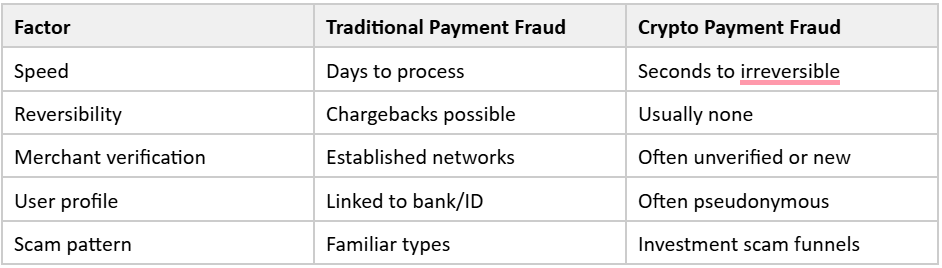
This table shows why generic fraud tools often miss crypto-specific scams. A specialised system needs to be built for this exact environment.
What Good Anti-Fraud Protection Actually Looks Like
If you are a crypto user or a platform evaluating payment protection, here is what to look for in an anti-fraud system:
- Real-time risk scoring on every transaction – not batch processing.
- Merchant and counterparty intelligence that flags known scam-linked entities.
- Behavioural analysis comparing current transaction against user history.
- Velocity checks to catch rapid or unusual deposit patterns.
- Integration with global fraud databases and law enforcement intelligence feeds.
- Clear user-facing friction when something looks off – like confirmation steps or delays.
Good systems do not just block bad transactions. They make it harder for scammers to set up the conditions for fraud in the first place.
What Crypto Users Can Do Right Now
Technology helps a lot. But users still play a role. Here are some practical things anyone can do:
- Only use platforms with verified payment processors and transparent fraud protection.
- Be sceptical of platforms promising guaranteed returns or unusually high profits.
- Check if the payment gateway has anti-fraud certification or regulatory approval.
- Never deposit more than you are comfortable losing on a new or unverified platform.
- If a withdrawal is blocked for no clear reason – that is a red flag. Stop depositing.
The crypto space is still maturing. Scammers know that. They target users who are new, excited, or not paying close attention. Anti-fraud tech helps close that gap – but users need to stay sharp too.
Where Anti-Fraud Tech Is Heading
AI is a double-edged sword here. Europol’s IOCTA 2026 warned that fraudsters are using AI to create more convincing fake platforms, tailor social engineering attacks, and automate scam operations at scale. But the same AI tools are being used on the defence side.
Modern anti-fraud systems are now using machine learning to adapt to new scam patterns in near real time. As criminals evolve, so does the technology fighting them. The velocity gap – the speed at which criminals can launch new attacks vs. how fast defenders can respond – is what everyone in the industry is trying to close.
Payment processors and fintech companies that work in the crypto space have a real responsibility here. Building fraud protection into the payment layer is not optional anymore. It is the baseline.
Also read: Crypto Withdrawal Reliability: How Secure Can Transactions Be – a closer look at how blockchain-level security and platform practices work together to keep your withdrawals safe.
Final Thoughts
Crypto payment fraud is a real and growing problem. It is not some edge case – it is an organised, professional industry targeting everyday users. Europol’s latest data confirms this.
The answer is not to avoid crypto. It is to demand better protection at every layer of the payment stack. From the blockchain to the card terminal.
Platforms that take fraud seriously – and build systems specifically for the crypto environment – are the ones that will earn user trust long-term. That is good for everyone. And it is exactly the kind of infrastructure the space needs more of right now.