
Why Your Club’s Betting Sponsor “Doesn’t Exist” in the UK (And Why You Still See the Logo)
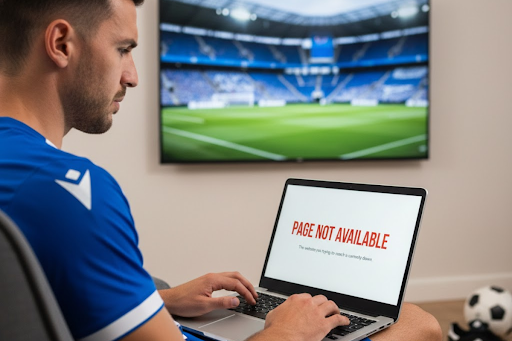
If you’ve ever seen a betting logo around a Premier League match and then tried to Google it… only to hit a dead end, you’re not imagining things.
A growing number of clubs have leaned into “regional” or overseas-facing gambling partnerships – deals designed to reach audiences in specific markets (often in Asia or Latin America) without targeting UK consumers directly. The result is a weird modern fan experience: a sponsor that’s visible on perimeter boards, in international broadcasts, or even on club channels – but appears inaccessible from a UK IP address.
It’s not an accident. It’s a strategy.
Why this is happening now
The immediate backdrop is the Premier League’s decision to phase out gambling sponsors from the front of matchday shirts from the 2026/27 season (a voluntary league-wide move). That doesn’t ban gambling marketing entirely – it’s specifically about the front-of-shirt slot. Sleeves, LED boards, and other inventory remain available.
For clubs, the commercial tension is obvious: front-of-shirt is premium real estate, and gambling brands have historically been among the most aggressive buyers. As that door narrows, some clubs and brands are leaning harder on the next best thing: “official regional betting partners” and international-facing operators that don’t hold a UK licence and don’t want (or aren’t allowed) to serve UK customers.
The Guardian has reported on this wider trend as clubs turn to “hidden” gambling partners – including examples referencing Chelsea and Fulham in the broader ecosystem – where the sponsor can be geo-blocked in the UK but still gets brand exposure through international audiences and matchday assets.
What “geo-blocked sponsor” actually means
Geo-blocking is the simplest part: the sponsor’s site may block UK visitors based on location signals like your IP address. You click, and you get a “not available in your region” message – or you can’t reach the site at all.
That’s not just brand theatre. It’s often used to support a legal/compliance argument:
- The club isn’t “promoting gambling to UK consumers” if the operator is not accepting UK customers and the website blocks UK access.
- The operator can still buy exposure to overseas audiences, where it is licensed (or operating) under different rules.
In practice, these deals can be structured around international broadcast visibility (think: LED boards seen globally), “regional content”, and overseas activations – while the UK fan sees the logo and thinks, “Wait… what even is that company?”
“Regional betting partner” vs “UK gambling operator”
Here’s the key distinction fans often miss:
A “regional betting partner” deal is primarily a marketing arrangement.
It doesn’t necessarily mean the brand is licensed in the UK, or that it can legally accept UK customers.
Chelsea’s deal with Roobet, for example, was announced by the club as an Official Regional Betting Partner for Latin America and Canada – explicitly framed as a 32-territory partnership, not a UK-facing gambling offer.
So, you’ll see the branding. But whether you can legally open an account from the UK (and whether you should) is a completely separate question.
Why clubs like these deals
From a club perspective, geo-blocked / overseas-facing partnerships have three big upsides:
- Money still comes in
Even as the most visible UK inventory tightens, clubs can still monetize international reach. - It’s “less risky” than a UK-facing gambling push
If the operator blocks UK customers, the club can argue the partnership is targeted elsewhere. - The exposure is still massive
Premier League matches are watched globally; a perimeter-board logo can be worth plenty if the sponsor is buying access to international eyeballs.
The regulator’s message: UK access is the red line
Here’s where it stops being just “weird marketing” and becomes a real compliance story.
In February 2025, the UK Gambling Commission warned clubs that promoting unlicensed gambling sites accessible to UK consumers can carry legal risk – including that club officers could face prosecution if they’re involved in promoting illegal gambling to people in Britain.
That warning matters because geo-blocking isn’t a magic shield. If UK consumers can still access the operator (directly, via mirror domains, or through sloppy controls), the partnership can become a problem fast.
The Commission’s core point is simple: if British consumers can gamble with the brand, it needs to be properly licensed for Britain – and clubs should do due diligence, not just accept “we’re not targeting the UK” at face value.
“Hidden” doesn’t just mean geo-blocked – it can also mean undisclosed
There’s another twist: sometimes the sponsor is not even clearly listed in a neat “partners” page, but still appears in matchday LED rotations or regional feeds. Industry coverage has raised disclosure questions about unlisted sponsors appearing during broadcasts.
This is why fans end up in a rabbit hole: they’ve seen the brand somewhere, but it’s not always obvious what the relationship is, where it applies, and whether it’s a UK-facing product.
The fan’s guide: how to tell if a gambling site is UK-licensed (and safer)
If you’re seeing gambling brands around football and you’re curious, the smartest move isn’t “find a way around the block.” It’s “verify what’s legit.”
Here’s a quick checklist:
1) Look for a UK licence – don’t assume.
A UK-licensed operator should be listed with the Gambling Commission (and will usually display UK licensing info clearly). If it’s not UK-licensed, it shouldn’t be taking UK customers.
2) Be suspicious of “works everywhere” crypto casinos.
Crypto-focused gambling platforms have grown fast globally, and a lot of consumer harm concerns revolve around weak checks and easy access in restricted markets.
3) Use self-exclusion and limit tools.
For UK audiences, a major safety baseline is access to tools like deposit limits, time-outs, and self-exclusion schemes (for example, GAMSTOP is commonly referenced in UK safer gambling conversations).
4) Compare offers like you would any financial product.
If you’re going to engage at all, compare terms, minimum deposits, wagering requirements, and withdrawal rules – and avoid anything that feels deliberately vague.
A practical starting point for UK readers who want to compare reputable offers (without chasing random sponsor logos) is a comparison hub like BestNewBingoSites – for example, their round-up of £5 deposit offers can help you understand what’s actually being advertised and what the terms tend to look like.
Where this goes next
The Premier League’s front-of-shirt change (2026/27) doesn’t remove gambling money from football – it shifts where it shows up. And as long as global broadcast reach stays valuable, international and “regional” gambling partnerships will remain tempting.
But the “hidden partner” era has a trust problem: when fans can’t easily verify who a sponsor is, where it operates, and whether it’s UK-licensed, the whole thing starts to look murky – even when parts of it are technically compliant.
So the best takeaway for supporters is brutally simple:
- A logo isn’t a recommendation.
- If you can’t access a sponsor in the UK, that’s usually the point.
- If you can access it, verify licensing and protections before you do anything else.
Because in 2026 football sponsorship isn’t just about what’s on the shirt – it’s about what’s being quietly sold around the edges, and who it’s really for.
