
The Gambler’s Brain: How Slot Machines & Loot Boxes Hack Your Psychology
“Just one more spin.” If you’ve ever muttered these words at 2 AM, wallet lighter and eyes heavy, you’re not weak-willed—you’re human. Slot machines and their digital cousins, loot boxes, are precision-engineered to override your better judgment. Understanding how these games hijack your brain’s reward system isn’t about killing the fun; it’s about playing with your eyes open to the psychological machinery at work.
The Perfect Storm: Why Slots Are Irresistible
Modern slot machines aren’t just games—they’re psychological masterpieces designed by teams of neuroscientists, mathematicians, and behavioural experts to maximise “time on device.”
Every element of a pokie machine serves a purpose in creating what researchers call “machine zone”—a trance-like state where time, money, and the outside world fade away. Whether you’re spinning reels at fortunica or your local RSL, these design principles remain constant. The combination of sensory elements creates an immersive experience that’s incredibly difficult to resist.
Key psychological hooks include:
- Rapid play speed: Minimises time between reward opportunities.
- Low bet options: “Only 50 cents” feels harmless repeatedly.
- Multi-line betting: Creates an illusion of frequent wins.
- Sensory overload: Lights, sounds, and animations trigger excitement.
- Comfort features: Ergonomic seats keep you playing longer.
Your Brain on Pokies: The Dopamine Loop Explained
When you play slots, your brain undergoes chemical changes similar to those experienced by drug users. This isn’t hyperbole—it’s neuroscience.
The gambling process triggers a fascinating cascade of brain activity:
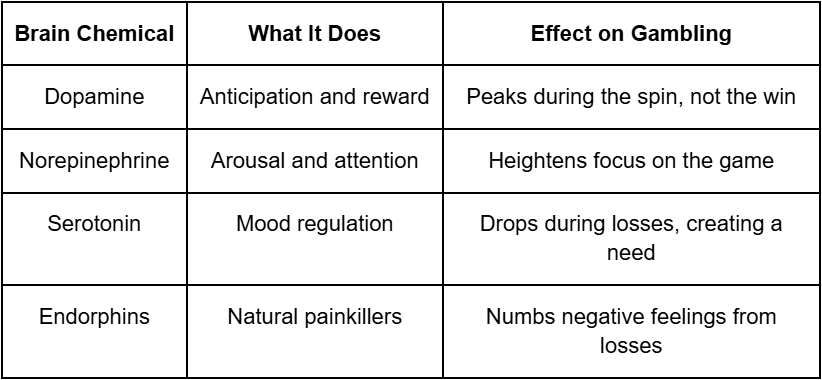
Surprisingly, brain scans show maximum dopamine release occurs during the spin—when the outcome is uncertain—not when you win. This anticipation becomes addictive itself.
Near Misses and False Wins: The Tricks That Keep You Playing
Casinos don’t rely on random chance alone. They employ sophisticated psychological tricks that exploit how our brains interpret patterns and results.
The most powerful manipulation techniques:
- Near-miss effect: Two cherries and one just above create false excitement.
- Losses disguised as wins: Celebrating when you “win” less than you bet.
- Symbol clustering: Jackpot symbols appear more frequently above/below the payline.
- False patterns: Random events that seem to follow patterns.
- Credit vs. cash: Tokens feel less real than money.
Studies show near-misses activate the same brain regions as actual wins, keeping you engaged despite losing. Your rational mind knows you lost, but your emotional brain screams, “So close!”
From Slots to Loot Boxes: Same Psychology, Different Screen
The psychology perfected in casinos has migrated to video games, creating a new generation of digital slot machines disguised as entertainment.
Comparing manipulation techniques:
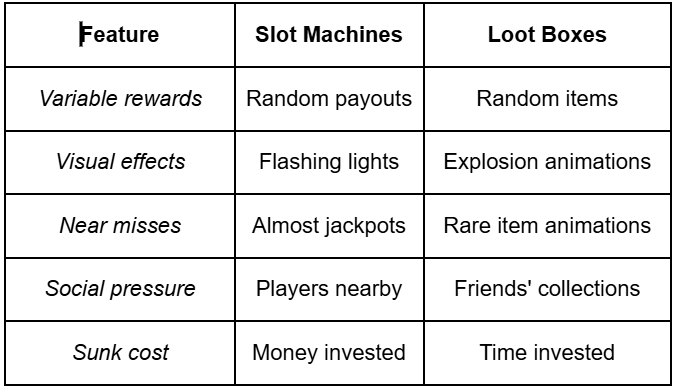
Modern games like FIFA, Overwatch, and mobile RPGs use identical psychological principles, targeting younger audiences who may not recognise gambling mechanics.
The Variable Ratio Schedule: Why Random Rewards Hook Us
The most powerful psychological force in gambling is the “variable ratio reinforcement schedule”—a fancy term for random rewards that explains why slots are more addictive than most activities.
How variable ratio schedules work:
- Unpredictable timing: Never knowing when you’ll win maintains constant anticipation.
- Inconsistent amounts: Small and large wins create excitement variety.
- Extinction resistance: Behaviour persists long after rewards stop.
- Partial reinforcement: Occasional wins strengthen behaviour more than constant wins.
- Hope maintenance: Random nature means next spin could always be “the one.”
This schedule is so powerful that rats will press levers until exhaustion when rewards follow this pattern. Humans aren’t much different.
Playing Smarter: Using Psychology to Your Advantage
Understanding these mechanisms doesn’t mean avoiding gambling entirely—it means making informed choices about your entertainment spending.
Strategies for maintaining control:
- Set hard limits before playing: Time and money boundaries.
- Use phone alarms: Break the trance state regularly.
- Calculate true cost: View losses as entertainment expense.
- Avoid chasing losses: Recognise sunk cost fallacy.
- Play socially: Friends provide reality checks.
Practical pre-gaming checklist:
- Decide the maximum loss amount.
- Set session time limit.
- Leave cards at home, bring cash only.
- Plan a post-gambling activity.
- Tell someone your limits.
Knowledge Is Power
Slot machines and loot boxes aren’t evil—they’re businesses using psychological principles to maximise engagement. Now that you understand the dopamine loops, near-miss effects, and variable ratio schedules at play, you’re equipped to make conscious choices about your gambling. The house edge ensures casinos profit mathematically, but psychological manipulation is what really empties wallets.
Want to test your newfound knowledge? Next time you gamble, observe your emotional responses to near-misses and notice when you’re chasing losses. Set a timer for regular breaks and stick to predetermined limits. Remember, the most powerful position isn’t avoiding these games entirely—it’s playing them with full awareness of how they work.
